Custom Software vs SaaS: What Investors Prefer
Understanding how software infrastructure decisions influence scalability, valuation, and investor confidence.
Investors evaluate far more than revenue projections and pitch decks.
They also evaluate the technology behind the business.
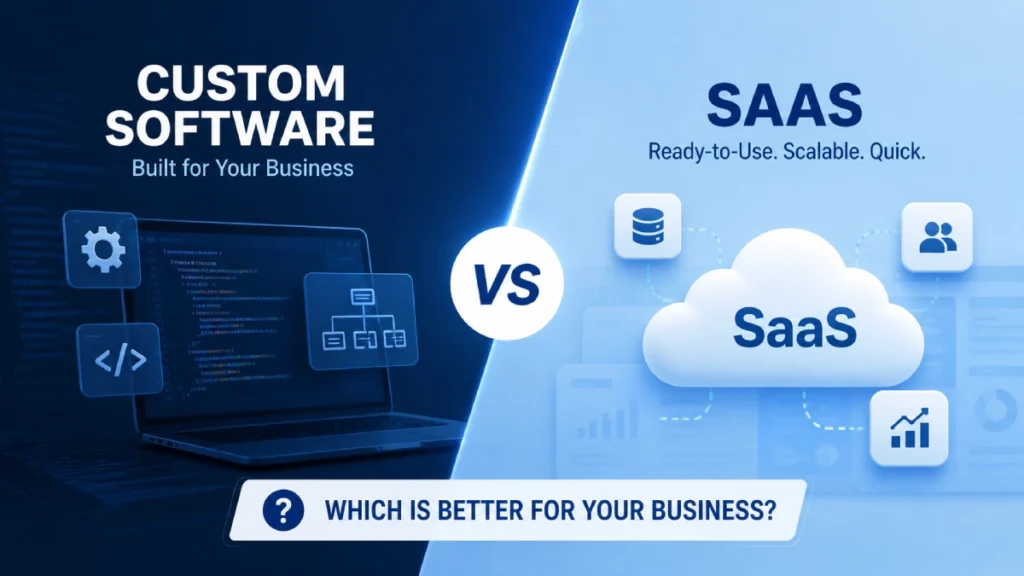
One of the biggest questions modern startups face is whether to rely on third-party SaaS platforms or invest in custom software systems.
The answer depends on scalability goals, operational complexity, and long-term competitive positioning.
“Investors do not simply invest in products — they invest in scalable operational infrastructure.”
What SaaS platforms provide
SaaS tools allow companies to launch operations quickly without building internal systems from scratch.
- Lower initial costs
- Faster deployment
- Minimal infrastructure management
- Prebuilt operational workflows
- Rapid startup execution
SaaS products work extremely well during early operational stages and product validation.
Where SaaS platforms become limiting
As startups scale, operational requirements become more complex.
- Limited customization
- Scalability restrictions
- Integration challenges
- Higher long-term subscription costs
- Dependency on external providers
- Operational bottlenecks
Investors often view heavy dependency on fragmented third-party systems as long-term operational risk.
Why custom software attracts investor confidence
Custom software gives startups greater control over scalability, infrastructure, and product evolution.
- Unique competitive advantages
- Scalable architecture systems
- Custom operational workflows
- Better infrastructure optimization
- Higher long-term flexibility
- Stronger intellectual property value
Investors often see custom systems as evidence of long-term strategic planning and technical maturity.
What investors actually care about
Investors are rarely focused on whether a company uses SaaS tools or custom software alone.
They focus on whether the infrastructure can support growth efficiently.
- Can the product scale reliably?
- Can operations evolve quickly?
- Does the system create defensibility?
- Can infrastructure handle growth?
- Is the technology future-ready?
The strongest startups typically combine strategic SaaS usage with custom infrastructure where differentiation matters most.
When startups should transition to custom systems
- Rapid user growth begins
- Operational complexity increases
- Third-party costs become excessive
- Custom workflows are required
- Performance optimization becomes critical
- Investor expectations increase
Transition timing is important.
Building custom systems too early can slow validation, while waiting too long can create expensive rebuilding cycles.
Why modern startups build hybrid infrastructure
Many successful companies combine SaaS platforms with custom software development.
- Third-party operational tools
- Custom backend systems
- API-first integrations
- Scalable cloud-native architecture
- Custom customer experiences
This approach balances speed, flexibility, and scalability while reducing unnecessary development overhead.
How Edge of Content helps startups scale intelligently
Edge of Content helps founders design scalable software infrastructure that supports fundraising, operational growth, and long-term technical flexibility.
- Custom SaaS development
- Cloud-native architecture
- API-first backend systems
- Scalable CRM platforms
- Modern UI/UX engineering
- Technical growth strategy
We help startups identify where SaaS tools accelerate growth and where custom systems create long-term competitive advantage.
Investors prefer infrastructure that scales intelligently.
The best technology strategy is rarely choosing between SaaS or custom software alone — it is knowing when and how to combine both effectively.