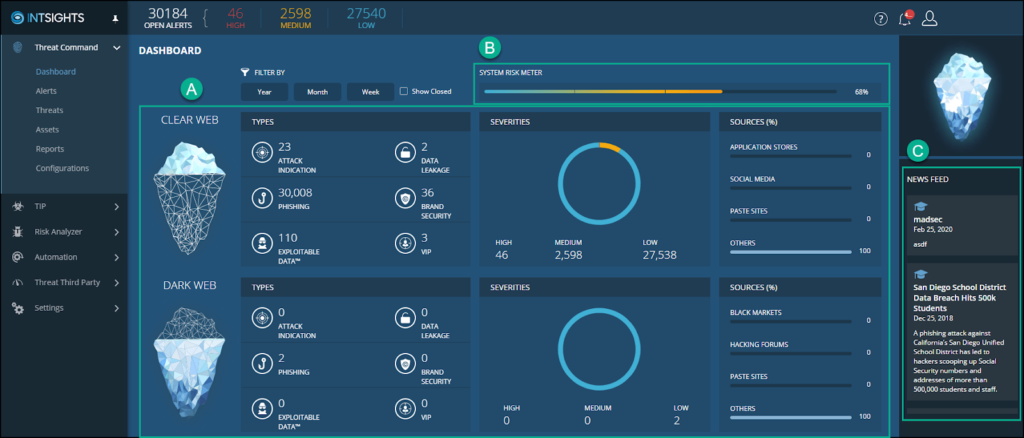
Building Real-Time Threat Monitoring Systems for Governments
Modern governments can no longer rely on delayed reporting, fragmented monitoring tools, or reactive security operations. National resilience increasingly depends on real-time threat visibility across digital infrastructure, communications networks, public systems, and critical services.
Real-time threat monitoring systems function as continuous national surveillance and defense layers designed to detect, correlate, and respond to cyber threats, operational anomalies, infrastructure attacks, and unauthorized activity as events occur.
Instead of waiting for incidents to escalate into disruptions, governments can establish unified monitoring environments capable of identifying hostile behavior across networks, applications, cloud infrastructure, telecommunications systems, financial platforms, and public digital services in real time.
Centralized National Visibility
Effective threat monitoring begins with visibility consolidation. Government agencies, infrastructure operators, telecommunications providers, financial institutions, and national service platforms often operate independently with fragmented security oversight.
A modern monitoring architecture aggregates logs, network telemetry, authentication events, API activity, endpoint behavior, and cloud infrastructure metrics into a centralized operational intelligence environment.
This unified visibility layer allows governments to identify coordinated threats that would otherwise remain hidden across disconnected systems.
Continuous Behavioral Analysis
Traditional security systems depend heavily on predefined signatures and static rules. Modern attacks increasingly bypass these methods by operating through legitimate credentials, trusted applications, and approved infrastructure channels.
Real-time monitoring platforms therefore rely on behavioral analytics capable of identifying anomalies in user activity, traffic flow patterns, system execution behavior, and operational deviations.
Sudden privilege escalation, unusual data transfers, abnormal authentication patterns, or suspicious API interactions can be detected immediately before escalation occurs.
AI-Driven Threat Correlation
Modern government infrastructure generates massive volumes of operational data that cannot be analyzed manually at national scale. Artificial intelligence and automated analytics systems are becoming essential components of advanced cyber defense operations.
AI engines can correlate threat indicators across multiple environments simultaneously, connecting seemingly unrelated activities into unified threat intelligence models.
This enables governments to identify coordinated attacks, infrastructure reconnaissance activity, insider threats, malware propagation, and sophisticated intrusion attempts much faster than traditional monitoring approaches.
Protection of Critical National Infrastructure
Modern monitoring systems extend far beyond government office networks. National resilience depends heavily on protecting energy infrastructure, transportation systems, telecommunications, healthcare services, financial platforms, emergency coordination systems, and public administration environments.
Real-time monitoring provides operational visibility into these sectors continuously, allowing rapid detection of infrastructure attacks, service disruptions, operational failures, or coordinated cyber campaigns targeting national stability.
The objective is not only cyber defense, but preservation of uninterrupted national operations during both technical and geopolitical crises.
Automated Defensive Response Systems
Speed is critical during active cyber incidents. Modern monitoring architectures increasingly integrate automated response mechanisms capable of containing threats without waiting for manual intervention.
Systems can dynamically isolate compromised endpoints, revoke suspicious access tokens, reroute network traffic, restrict API activity, or quarantine affected infrastructure segments in real time.
Automated containment dramatically reduces attacker movement while preserving operational continuity across unaffected systems.
Sovereign Threat Intelligence and Operational Control
Governments increasingly require sovereign control over monitoring infrastructure, data routing, and national threat intelligence systems. Dependence on externally controlled monitoring environments creates strategic visibility and jurisdictional risks.
Sovereign monitoring architecture allows governments to maintain internal control over sensitive operational telemetry, incident response coordination, and infrastructure defense strategy.
This strengthens national resilience while reducing exposure to external operational dependency during periods of instability or geopolitical tension.
National resilience now depends on operational visibility at machine speed.
Governments that can detect, correlate, and respond to threats in real time will control the future stability of their digital infrastructure and national operations.