What Is Cyber Security Monitoring?
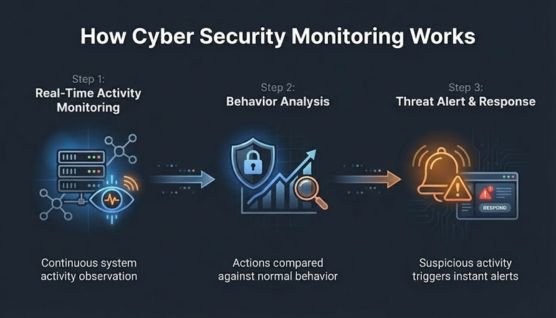
Cyber security monitoring is the continuous process of observing, analyzing, and responding to digital activity across systems, applications, APIs, infrastructure, and user environments to detect threats before they escalate into operational compromise.
Most organizations today operate across fragmented digital environments that include cloud services, APIs, internal systems, employee devices, external platforms, and third-party infrastructure providers. Every interaction inside this ecosystem generates operational exposure.
Cyber security monitoring creates continuous operational visibility across these environments, allowing organizations and governments to identify malicious activity, abnormal behavior, unauthorized access attempts, infrastructure anomalies, and data exposure risks in real time.
Why Traditional Monitoring Is No Longer Enough
Legacy monitoring systems were designed around static infrastructure and perimeter-based security models. Modern digital ecosystems are far more dynamic. Employees work remotely, APIs connect external services, cloud platforms process sensitive data, and attackers increasingly operate through trusted applications and legitimate credentials.
Traditional monitoring tools often fail because they only observe isolated infrastructure layers instead of understanding the full operational context of user behavior, application interactions, API activity, and data movement.
Modern threats no longer rely solely on brute-force intrusion. They exploit fragmented visibility, operational blind spots, credential abuse, trusted sessions, and uncontrolled application behavior.
How EdgeOfContent Extends Cyber Security Monitoring
EdgeOfContent introduces a sovereign application-layer monitoring and policy enforcement architecture designed to operate invisibly between users and external digital services.
Instead of monitoring only network traffic or infrastructure logs, the platform continuously evaluates real-time interactions occurring across applications, APIs, cloud environments, authentication systems, user sessions, and external platform communications.
This creates a behavioral visibility layer capable of identifying threats that traditional firewalls, VPNs, and isolated monitoring tools often fail to detect.
Real-Time Behavioral Threat Detection
EdgeOfContent continuously analyzes operational behavior instead of relying entirely on static security signatures. The platform evaluates traffic anomalies, suspicious API calls, unusual authentication behavior, abnormal session activity, privilege escalation attempts, and unauthorized data movement in real time.
Because monitoring occurs at the application interaction layer, the system can detect threats operating inside legitimate workflows rather than only blocking external attacks at the perimeter.
This dramatically improves visibility into insider threats, compromised accounts, malicious automation, API abuse, and coordinated infrastructure attacks.
Sovereign Policy Enforcement
EdgeOfContent is designed around sovereign digital control principles. Organizations and governments can enforce jurisdictional routing policies, application governance rules, access restrictions, compliance controls, and infrastructure-level operational policies directly at the application layer.
This allows sensitive sectors such as finance, government, defense, telecommunications, and public infrastructure to maintain visibility and control over how external services interact with internal systems.
Instead of depending entirely on third-party infrastructure providers for security visibility, organizations retain operational intelligence internally.
Automated Containment and Adaptive Defense
Once suspicious behavior is identified, EdgeOfContent can dynamically enforce policy actions in real time. Sessions can be isolated, API interactions restricted, suspicious requests blocked, traffic rerouted, or compromised environments segmented automatically.
The objective is not simply threat observation. The platform is designed to actively reduce attacker movement while maintaining operational continuity across unaffected systems.
This transforms monitoring from passive visibility into active operational defense infrastructure.
Cyber Monitoring as an Operational Control Layer
Modern cybersecurity is increasingly shifting away from isolated security tools toward unified operational governance architectures.
EdgeOfContent positions cyber security monitoring as a real-time operational intelligence layer capable of understanding behavior, enforcing policy, reducing infrastructure exposure, and protecting digital ecosystems continuously.
The future of cyber defense depends on visibility across interactions — not just infrastructure.
Monitoring alone is no longer enough.
EdgeOfContent transforms cyber security monitoring into a sovereign application-layer defense system capable of detecting, governing, and containing threats across modern digital environments in real time.