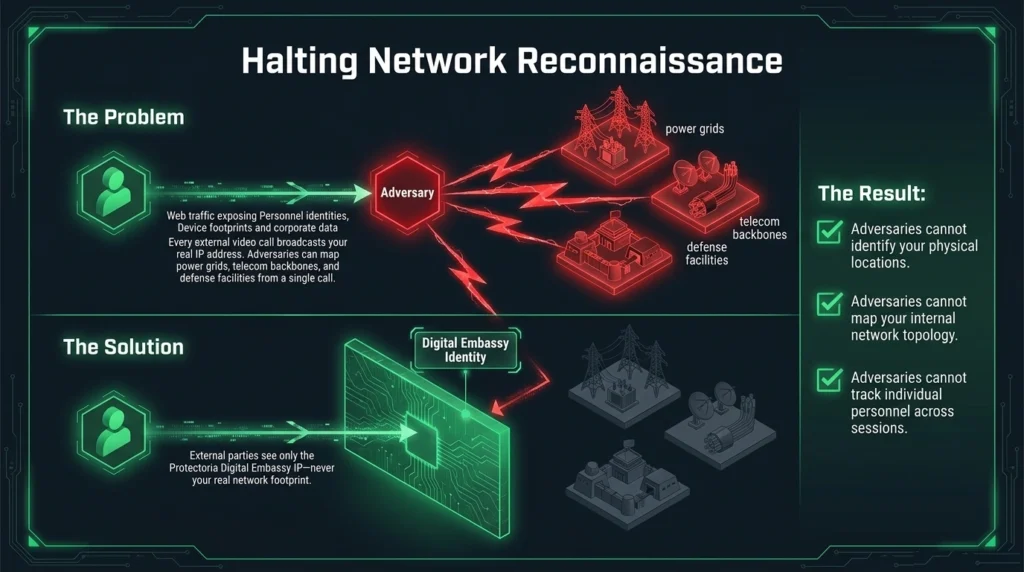
Halting Network Reconnaissance in Critical Government Infrastructure
Preventing early-stage network mapping is one of the most effective ways to reduce exposure of government systems to coordinated cyber threats.
Network reconnaissance is the initial phase of most cyber intrusions. It involves mapping infrastructure, identifying exposed services, and profiling system behavior before exploitation attempts begin.
In government environments, uncontrolled reconnaissance activity creates a persistent intelligence layer for adversaries targeting national systems.
Why Network Reconnaissance Is a Critical Security Phase
Before any direct attack occurs, systems are scanned for open ports, API endpoints, authentication weaknesses, and infrastructure topology.
This information is used to design targeted intrusion strategies against high-value government assets.
Common Reconnaissance Vectors in Government Systems
Reconnaissance does not always appear as a direct attack. It often blends into normal traffic patterns and system interactions.
- Automated port scanning of exposed government services
- DNS enumeration of public-facing infrastructure
- API probing and endpoint discovery
- Metadata harvesting from web applications
- Traffic analysis of embassy and consulate networks
- Social engineering data collection across public systems
The Structural Weakness That Enables Reconnaissance
Reconnaissance becomes effective when systems are overly exposed, inconsistently segmented, or insufficiently monitored.
Lack of unified logging, weak perimeter controls, and fragmented infrastructure increase visibility for external actors.
Techniques for Halting Network Reconnaissance
Effective prevention requires architectural constraints that reduce observable attack surfaces and limit information disclosure.
- Strict network segmentation across all government services
- Zero-trust authentication for all inbound and internal requests
- Rate limiting and behavioral anomaly detection
- Hiding internal topology behind secure gateways
- Disabling unnecessary service exposure on public endpoints
- Encrypted traffic inspection and monitoring systems
Reducing the Attack Surface at Infrastructure Level
The most effective defense against reconnaissance is minimizing what can be observed externally.
This includes reducing exposed services, standardizing secure APIs, and eliminating unnecessary public-facing endpoints.
Continuous Monitoring and Early Detection
Real-time detection systems are required to identify abnormal scanning behavior before it escalates into targeted intrusion attempts.
This requires centralized observability across all ministries, embassies, and critical infrastructure networks.
Network reconnaissance is not a breach.
It is the intelligence phase that determines whether a breach will eventually succeed.