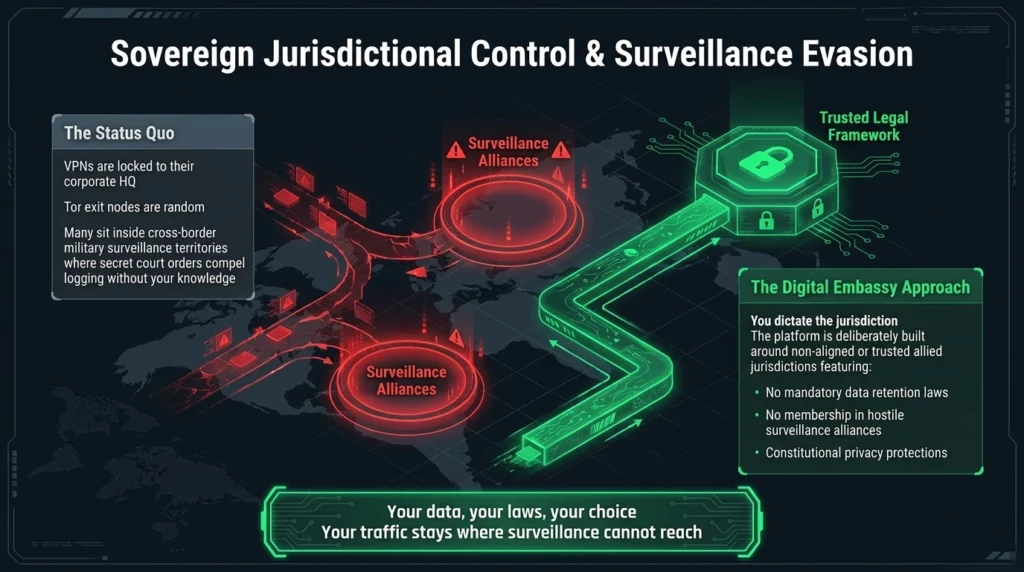
Sovereign Jurisdictional Control & Surveillance Evasion in Modern Digital Infrastructure
True sovereignty in the digital era is defined by jurisdictional control over data, systems, and communication layers—without unintended external visibility or dependency.
Government systems increasingly operate across distributed cloud environments, cross-border networks, and vendor-managed infrastructure stacks.
Without strict jurisdictional design, sensitive data and system operations can unintentionally pass through external legal or operational domains.
Sovereign Jurisdictional Control in Digital Systems
Jurisdictional control ensures that all critical infrastructure components remain governed under national law, policy, and operational authority.
This includes data residency, infrastructure hosting boundaries, encryption control, and administrative access governance.
The Hidden Risk of Cross-Border Infrastructure Exposure
Many modern systems rely on global cloud services and third-party tools that may introduce unintended data routing, replication, or administrative exposure outside national jurisdiction.
This creates structural ambiguity over who can legally or technically access sensitive government information.
Surveillance Exposure Through Infrastructure Dependencies
Surveillance exposure is not limited to direct interception. It can occur through metadata leakage, logging systems, third-party analytics, and infrastructure monitoring layers.
Even encrypted systems may leak operational patterns if infrastructure ownership is external or fragmented.
Engineering Sovereign Infrastructure Boundaries
Sovereign architecture requires strict separation between internal government systems and external service providers.
- National-controlled data centers and cloud environments
- End-to-end encryption with locally managed keys
- Strict API governance and access segmentation
- Isolated communication layers for sensitive operations
- Auditability across all infrastructure interactions
Surveillance Resistance Through System Design
Surveillance resistance is achieved not through single tools, but through architectural constraints that limit unintended data exposure.
This includes minimizing external dependencies, controlling metadata flows, and enforcing strict data lifecycle governance.
Why Jurisdictional Control Defines Digital Sovereignty
A government does not fully control its digital systems if critical components operate outside its legal or technical jurisdiction.
Sovereignty requires alignment between infrastructure ownership, operational control, and legal authority.
Digital sovereignty is not only about access control.
It is about ensuring that no part of critical infrastructure operates outside national jurisdictional boundaries.