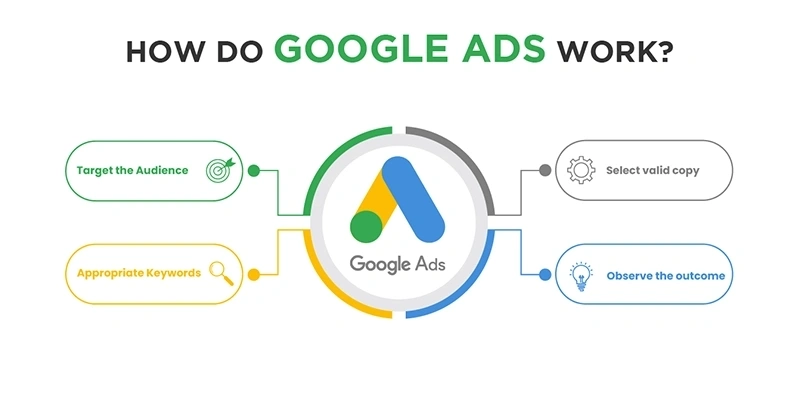
In today’s digital economy, businesses cannot rely solely on organic reach to generate consistent traffic and sales. Google Ads has become one of the most powerful tools for gaining immediate visibility, attracting high-intent users, and driving measurable results. Understanding how Google Ads works is essential for any business aiming to compete effectively online and scale its customer acquisition strategy.
Google Ads operates on a pay-per-click model, where businesses bid on specific keywords to display their ads on Google search results and partner websites. When a user searches for a product or service, Google runs an instant auction to determine which ads appear and in what order. This decision is not based only on the highest bid but also on ad relevance, expected click-through rate, and landing page quality. This means businesses with well-optimized campaigns can outperform competitors even with lower budgets.
The foundation of a successful Google Ads campaign starts with keyword strategy. Businesses must target keywords that match user intent, especially high-converting search terms related to their services or products. Keywords are grouped into tightly structured ad groups, allowing more precise targeting and better ad performance. Negative keywords are also used to filter out irrelevant traffic, ensuring that budgets are spent only on qualified prospects.
Ad creation is another critical component. Effective ads are clear, relevant, and aligned with what users are searching for. Strong headlines, compelling descriptions, and clear calls to action increase click-through rates and improve overall campaign performance. Extensions such as call buttons, location details, and additional links further enhance visibility and user engagement.
Landing pages play a major role in converting traffic into leads or sales. When users click on an ad, they should be directed to a page that matches their intent and provides a seamless experience. Fast loading speeds, mobile responsiveness, clear messaging, and optimized design significantly impact conversion rates. A well-structured landing page can reduce cost per acquisition while increasing return on ad spend.
Budget and bidding strategies determine how efficiently campaigns perform. Businesses can choose between manual bidding, where they control cost per click, or automated strategies that optimize for conversions, clicks, or impressions. Continuous monitoring and optimization are essential to adjust bids, pause underperforming keywords, and scale high-performing campaigns.
Data and analytics are at the core of Google Ads success. Campaign performance is measured through metrics such as click-through rate, conversion rate, cost per click, and return on investment. By analyzing this data, businesses can refine their targeting, improve ad copy, and optimize landing pages for better results over time.
At Edge of Content, a Bali-based software development, cybersecurity, SEO, and digital growth agency, we design and manage Google Ads campaigns with a performance-driven approach. We handle keyword research, campaign structuring, ad creation, landing page optimization, and continuous performance tracking to ensure maximum return on investment. Our strategies are aligned with SEO efforts, creating a unified system where paid and organic channels support each other for long-term growth.
For businesses looking to generate immediate traffic, increase leads, and scale revenue, Google Ads is not just an option—it is a critical component of a modern digital strategy. With the right execution, it becomes a powerful engine for growth, delivering consistent and measurable results in competitive markets.
info@edgeofcontent.com
https://wa.me/6285692850857