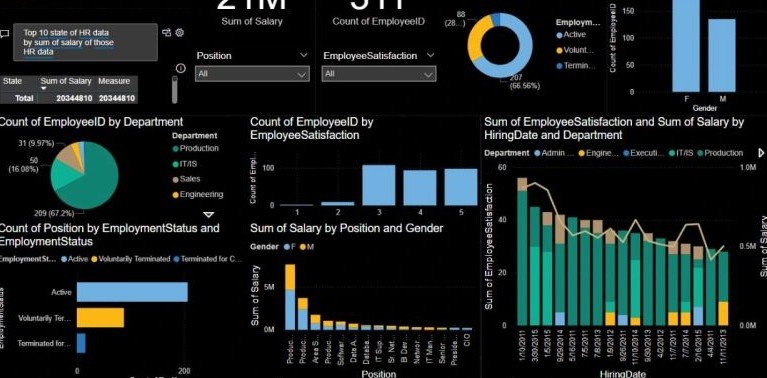
Why Ministries Need Internal Analytics and Reporting Dashboards
Modern ministries operate complex, high-volume systems spanning public services, budgets, procurement, staffing, infrastructure programs, and national policy execution. Without internal analytics and reporting dashboards, decision-making becomes slow, fragmented, and dependent on outdated reports rather than real-time operational intelligence.
1. Ministries Operate Blind Without Unified Data
Most ministries collect large volumes of operational data across departments, but this data is often siloed in disconnected systems. Finance, procurement, HR, and service delivery platforms rarely share a unified analytical layer.
The result is decision-making based on fragmented snapshots rather than a complete operational picture.
2. Reporting Delays Reduce Policy Effectiveness
Traditional government reporting cycles are slow, often relying on monthly or quarterly manual aggregation. By the time reports reach decision-makers, the underlying data is already outdated.
This delay weakens policy responsiveness and reduces the ability to detect emerging issues early.
3. Budget Oversight Requires Real-Time Visibility
Ministries manage large-scale budgets across programs, contractors, and infrastructure initiatives. Without dashboards, financial oversight becomes reactive rather than preventive.
Real-time analytics can detect overspending, underutilization, procurement delays, and inefficiencies before they escalate into structural problems.
4. Operational Performance Cannot Be Managed Manually
Ministries oversee thousands of concurrent operations across regions, agencies, and service units. Manual reporting systems cannot scale to this level of complexity.
Dashboards provide centralized visibility into KPIs such as service delivery speed, infrastructure progress, workforce utilization, and program effectiveness.
5. Cross-Ministry Coordination Depends on Shared Intelligence
Many national initiatives require coordination across multiple ministries — such as health, finance, transportation, and interior affairs. Without shared analytics layers, coordination becomes slow and inconsistent.
Unified dashboards enable synchronized decision-making across institutions using the same real-time data sources.
6. Risk Detection Requires Continuous Monitoring
Ministries face operational risks ranging from budget misallocation to infrastructure delays and service disruptions. Without continuous analytics, these risks are often detected too late.
Dashboards introduce proactive monitoring that flags anomalies in real time across financial, operational, and administrative systems.
What EdgeOfContent Does
EdgeOfContent is a sovereign government analytics and infrastructure platform that unifies operational data, institutional reporting, and real-time intelligence into a single decision layer for ministries.
It replaces fragmented reporting pipelines with a centralized analytics architecture designed for national-scale governance environments.
Core capabilities include:
• Real-time ministry-wide analytics dashboards
• Cross-department KPI tracking and visualization
• Budget monitoring and expenditure intelligence
• Procurement and project performance tracking
• Operational anomaly detection across agencies
• Secure sovereign data aggregation and reporting layers
Ministries cannot manage what they cannot see in real time.
EdgeOfContent builds sovereign analytics infrastructure that gives ministries unified visibility into operations, budgets, and national program performance through real-time dashboards and intelligence systems.
Deploy Ministry Analytics Infrastructure