Why VPNs, Firewalls, and Tor Still Fail to Stop Modern Cyber Threats
Security tools fail when organizations mistake isolated protection layers for complete security architecture. Modern cyber threats exploit behavioral gaps, application logic, human trust, and operational complexity far beyond network-level defenses.
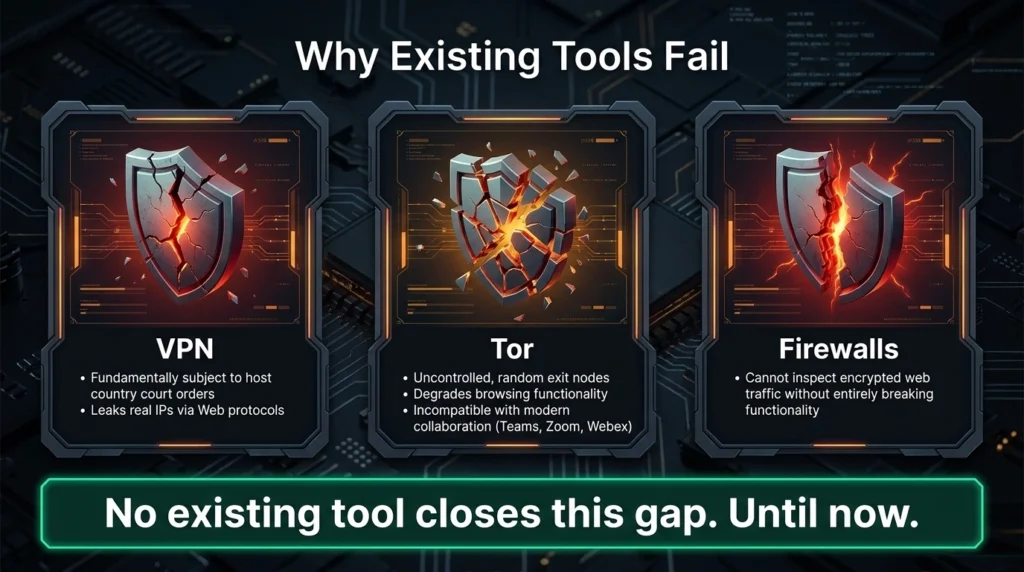
VPNs, firewalls, and anonymity networks were designed to solve specific security problems. A firewall filters network traffic. A VPN encrypts transport paths. Tor obscures routing identity. None of these technologies were built to fully understand intent, user behavior, application logic, or compromised endpoints.
Modern attacks no longer focus only on breaking through infrastructure barriers. Attackers increasingly exploit trusted sessions, APIs, cloud integrations, browser behavior, identity systems, supply chains, and human decision-making.
Encryption Does Not Equal Trust
VPNs encrypt traffic between endpoints, but they do not verify whether the endpoint itself is compromised. If malware already exists on a device, encrypted tunnels simply protect malicious traffic as effectively as legitimate traffic.
Attackers regularly abuse VPN infrastructure using stolen credentials, session hijacking, token theft, or infected employee devices. Once authenticated access is obtained, the VPN often becomes a protected corridor for internal compromise.
Firewalls Cannot Fully Understand Application Intent
Traditional firewalls inspect ports, protocols, IP addresses, and traffic rules, but modern attacks increasingly operate inside legitimate application behavior.
Malicious API calls, browser-based exploits, phishing sessions, credential abuse, cloud misconfigurations, and encrypted payloads can all pass through allowed channels without triggering network-level restrictions.
In many environments, attackers no longer need to “break in.” They simply operate through trusted applications already permitted by security policies.
Tor Protects Anonymity, Not Endpoint Integrity
Tor was designed to obscure routing identity and resist traffic correlation, not to secure infected systems or malicious applications running locally.
If a browser leaks metadata, if malware bypasses Tor routing, or if users reveal identifying behavior patterns, anonymity can collapse despite encrypted relay chains.
Threat actors also exploit Tor itself for command-and-control infrastructure, anonymous hosting, phishing operations, and covert communication channels.
Human Behavior Remains the Largest Attack Surface
Most major compromises occur through human interaction rather than direct infrastructure exploitation. Social engineering, phishing, credential reuse, malicious attachments, and trust manipulation consistently bypass technical protections.
Attackers target psychology because it scales faster than attacking hardened infrastructure directly. A single compromised employee account can bypass millions of dollars of security infrastructure instantly.
Security Fragmentation Creates Invisible Gaps
Modern organizations operate across cloud providers, SaaS platforms, APIs, remote work environments, mobile devices, third-party vendors, and distributed identity systems.
Each additional integration creates trust dependencies and visibility gaps. Security tools operating independently often fail to correlate threats across the full operational ecosystem.
Attackers exploit these disconnected layers by moving laterally between services that were never designed to share unified security intelligence.
Modern Threats Require Continuous Behavioral Governance
Static perimeter defense is no longer sufficient. Modern cyber defense increasingly depends on continuous monitoring of behavior, identity trust, application interactions, device integrity, and real-time contextual analysis.
Security systems must evolve from passive filtering into adaptive governance architectures capable of understanding intent, detecting anomalies, and enforcing policy dynamically across all operational layers.
Modern cyber threats rarely attack the strongest layer directly.
They exploit trusted behavior, fragmented systems, and invisible operational assumptions that traditional security tools were never designed to fully understand.