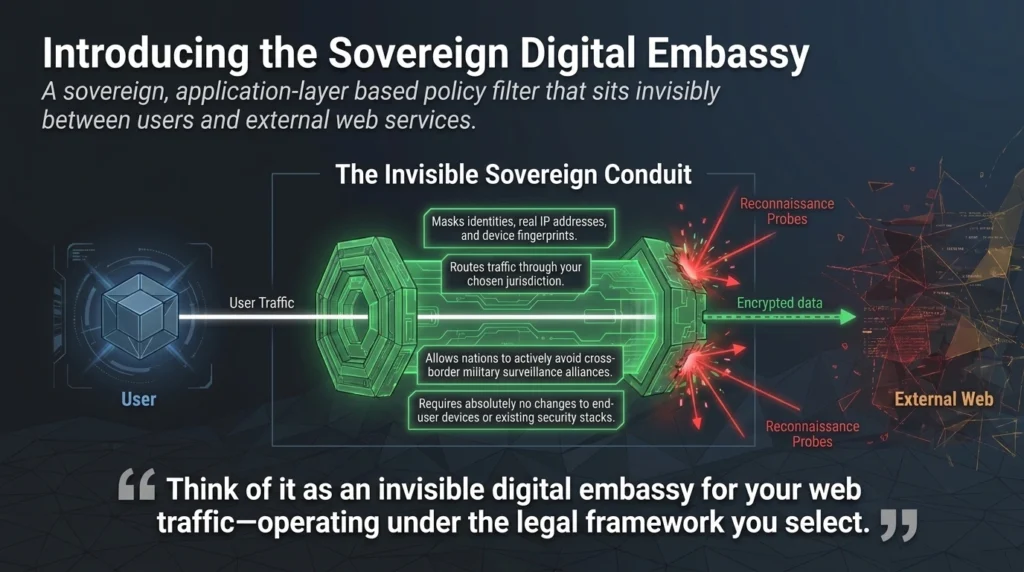
Sovereign Application Layer Policy Filtering for National Digital Control
Modern digital sovereignty is no longer achieved solely through infrastructure ownership. True control now exists at the application layer — where requests, data flows, user behavior, and external platform interactions are continuously governed in real time.
A sovereign application-layer policy filter functions as an invisible enforcement framework positioned between users and external digital services. Instead of blocking internet access outright, the system intelligently regulates how applications, APIs, cloud services, and web platforms interact with internal national or enterprise environments.
The architecture operates transparently across devices, browsers, enterprise systems, and mobile applications without introducing operational friction. Users continue interacting with platforms normally while the policy layer continuously evaluates requests, sessions, metadata, payload structures, and behavioral patterns in real time.
Intelligent Traffic Governance
Every outbound and inbound interaction can be evaluated against sovereign digital policies before execution. This includes API requests, SaaS communications, encrypted traffic routing, authentication flows, and cloud platform integrations.
Instead of relying on static firewall rules, the platform introduces adaptive enforcement logic capable of analyzing context, behavioral anomalies, jurisdictional risk, device trust levels, and operational sensitivity simultaneously.
This allows governments and enterprises to prevent unauthorized data transfers, shadow IT usage, unapproved third-party integrations, or hostile communication attempts without disrupting legitimate operational workflows.
Sovereign Routing and Jurisdictional Enforcement
Digital sovereignty requires more than data storage compliance. It requires full visibility into where information travels, how services process requests, and which external jurisdictions gain exposure to internal activity.
The application-layer policy system can route traffic through sovereign infrastructure corridors, enforce domestic compliance rules, and selectively isolate or restrict interactions with external providers based on national security policies.
This creates a controlled digital perimeter where strategic sectors such as finance, telecommunications, defense, energy, and public administration operate under continuously enforced jurisdictional governance.
API Mediation and External Platform Control
Modern institutions increasingly depend on external APIs, cloud infrastructure, and SaaS ecosystems that introduce hidden operational dependencies. The policy layer acts as an intelligent mediator between internal systems and third-party platforms.
Every external integration can be monitored, rate-limited, audited, sanitized, or selectively restricted based on policy enforcement requirements. This dramatically reduces uncontrolled data exposure while maintaining interoperability with global digital services.
By controlling interactions at the application layer rather than blocking platforms entirely, organizations preserve operational flexibility without sacrificing sovereignty or security posture.
Integrated Threat Intelligence and Defensive Automation
The platform continuously correlates live traffic behavior with threat intelligence feeds, anomaly detection engines, and behavioral analytics systems. Suspicious activity can be intercepted before escalation occurs.
This includes detection of command-and-control traffic, credential abuse, data exfiltration attempts, malicious API calls, reconnaissance patterns, and coordinated digital intrusion activity targeting national infrastructure.
Automated defensive responses can dynamically quarantine sessions, reroute traffic, revoke permissions, or isolate high-risk interactions in milliseconds without interrupting broader system operations.
Invisible Enforcement Without Operational Friction
The most effective security architectures are invisible to end users. Rather than slowing operations through excessive restrictions, the sovereign application layer is designed to enforce governance silently in the background.
This creates an environment where security, compliance, and sovereignty policies become embedded directly into digital execution flows instead of functioning as external obstacles.
The result is a scalable national-grade digital control architecture capable of protecting critical infrastructure, regulating external dependencies, and maintaining continuous operational continuity across interconnected systems.
Digital sovereignty is enforced at the interaction layer.
The future of national cyber control depends on intelligent policy enforcement operating invisibly between users, applications, cloud platforms, and external digital ecosystems.