En
En Fr
Fr العربية
 BI
BI 中文
中文 РФ
РФFinTech · Digital Payments · West Africa · Financial Infrastructure
West African Digital Payment Infrastructure: Building the Open Financial Layer of the UEMOA
West Africa is entering a new era of digital finance. Mobile money, electronic money institutions, banks, payment institutions, instant payments, QR payments, digital wallets, and API-driven financial services are rapidly changing how individuals and businesses move money. The next opportunity is not to build another telecommunications company. It is to build the financial technology infrastructure that connects consumers, merchants, developers, banks, electronic money issuers, payment institutions, and interoperable payment rails through one simpler digital experience.
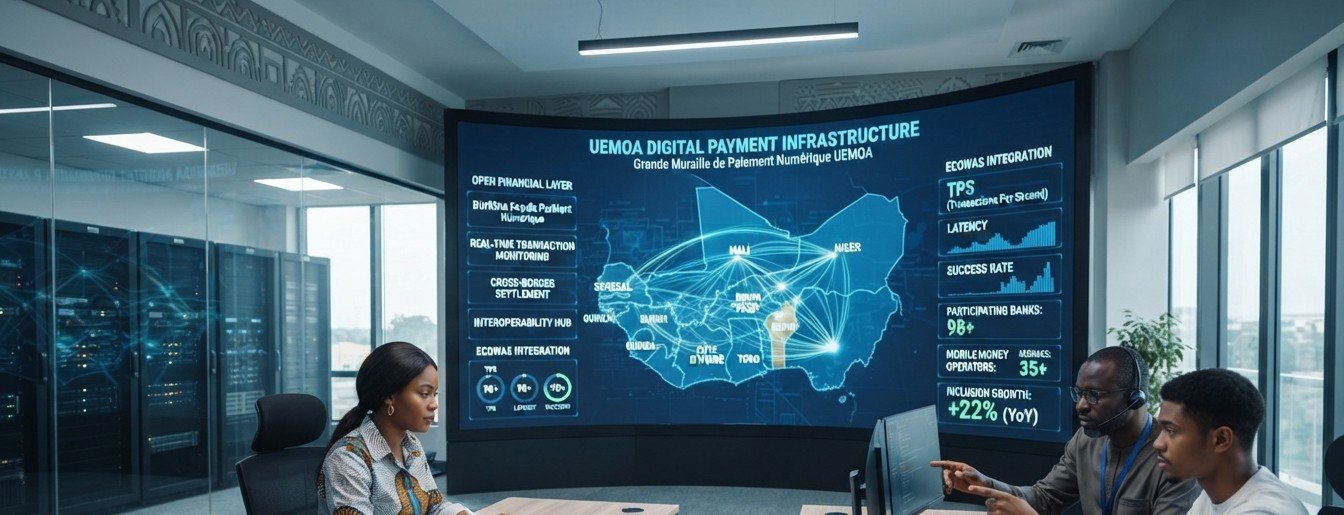
The proposed platform is designed as an office-light, API-first, mobile-first financial infrastructure company. Rather than investing billions in telecommunications infrastructure, SIM distribution, retail branches, and cellular networks, the model focuses capital on software engineering, regulatory compliance, cybersecurity, financial infrastructure, partnerships, and customer experience.
The objective is simple: make digital payments easier for customers, dramatically easier for developers, more accessible to merchants, and more efficient to operate than traditional financial-service distribution models.
The Investment Thesis
The opportunity is to build a West African financial technology platform that acts as an open payment infrastructure layer rather than a closed telecommunications ecosystem. Consumers receive a digital wallet and simple payment experience. Merchants receive QR payments, checkout, invoicing, transaction management, and analytics. Developers receive free APIs, SDKs, webhooks, sandbox environments, documentation, and payment infrastructure that can be integrated into any website or mobile application.
The platform can initially connect to licensed financial institutions and payment providers, while progressively developing its own regulated capabilities as scale, capital, partnerships, and regulatory approvals permit.
- API-First Financial Infrastructure – Developers integrate once instead of building separate integrations for every financial provider.
- Open Payment Architecture – Designed to connect banks, electronic money issuers, payment institutions, and interoperable payment infrastructure.
- QR-First Merchant Acceptance – One digital payment experience for physical and online commerce.
- Office-Light Operations – Technology replaces expensive branch and retail infrastructure wherever regulation permits.
- Developer-Led Growth – Free APIs and SDKs create a distribution channel through thousands of software applications.
- West African Expansion – Architecture designed for the eight UEMOA member states rather than a single-country product.
Why Now? The West African Payment Infrastructure Opportunity
The regulatory and technological environment is becoming increasingly favorable to payment fintechs. BCEAO’s Instruction n°001-01-2024 of 23 January 2024 establishes a regulatory framework for payment services across the Union Monétaire Ouest Africaine and applies to the UEMOA member states, including Mali. BCEAO itself describes the framework as supporting the development of payment fintechs and technological innovation while strengthening user protection, fraud prevention, and cybersecurity.
At the infrastructure level, BCEAO launched the Plateforme Interopérable du Système de Paiement Instantané, or PI-SPI, on 30 September 2025. PI-SPI is designed to make payments interoperable across financial institutions in the UEMOA and operates continuously, 24 hours a day, seven days a week. By 2 April 2026, BCEAO reported 80 connected participants, including banks, electronic money institutions, microfinance institutions, and a payment institution.
This infrastructure changes the strategic opportunity. Instead of building another isolated payment network, a new generation of fintech companies can focus on the software layer that makes interoperable financial infrastructure simple for consumers, merchants, businesses, and developers.
The Consumer Digital Wallet
The consumer application provides a modern digital wallet designed around simplicity, speed, transparency, and interoperability.
- Digital wallet account
- Wallet-to-wallet transfers
- Send money
- Receive money
- Merchant payments
- QR payments
- Payment requests
- Transaction history
- Digital receipts
- Refunds
- Payment notifications
- Bill payments through supported partners
- Airtime and data purchases through supported partners
- Bank-to-wallet and wallet-to-bank services where supported
- Cross-border payment capabilities as regulatory and infrastructure conditions permit
The long-term platform can also support virtual cards, physical cards, international transfers, savings, credit, insurance, and other financial services through appropriately licensed partners.
Universal QR Payments
QR payments provide one of the simplest ways to bring digital finance to physical commerce. A merchant can display a permanent QR code, generate a dynamic QR code for a specific invoice, or generate QR payment requests directly through an API.
- Static QR – Customers scan and enter the amount.
- Dynamic QR – A unique payment request contains the merchant, invoice, amount, and transaction reference.
- API QR – Websites, ecommerce platforms, marketplaces, restaurants, ride-hailing applications, and other software generate QR codes automatically.
- Interoperable QR – Designed to operate with the evolving UEMOA payment ecosystem and applicable standards.
BCEAO’s PI-SPI infrastructure already provides an interoperable QR concept in which a single QR code can be used to receive payments across the UEMOA regardless of the country of the payer’s account institution. This creates a powerful foundation for developers and merchants who want broad payment acceptance without maintaining multiple disconnected QR systems.
Free Payment API: The Developer Growth Engine
The platform’s strongest competitive advantage can be its developer ecosystem. Developers should not have to negotiate individually with every wallet provider, bank, or payment network before integrating digital payments.
A developer creates an account, enters the sandbox, receives API credentials, creates test transactions, generates QR codes, configures webhooks, and moves into production through a controlled onboarding process.
- Free Payment API
- REST API
- API Keys
- OAuth2
- HMAC request signing
- Idempotency Keys
- Webhooks
- Sandbox Environment
- Developer Dashboard
- API Documentation
- Transaction Logs
- Payment Testing
- QR Generation API
- Checkout API
- Refund API
- Payment Request API
- Settlement API
Official SDKs can eventually be provided for PHP, Node.js, Python, Java, Go, .NET, JavaScript, React, React Native, and other popular development environments.
Developer Platform
The developer platform becomes a distribution network. Every ecommerce website, SaaS platform, marketplace, ride-hailing application, restaurant application, accounting platform, school platform, and mobile application integrating the payment API effectively becomes part of the financial infrastructure ecosystem.
Merchant Payment Infrastructure
Merchants receive a complete digital payment environment rather than simply a wallet account.
- Merchant wallet
- QR payment acceptance
- Online checkout
- Payment links
- Invoices
- Refund management
- Transaction history
- Settlement tracking
- Employee and business accounts
- Merchant analytics
- Digital receipts
- API integration
- Webhook notifications
- Business reporting
The objective is to make accepting digital payments as easy for a small merchant as opening a social media account, while giving larger enterprises the API, security, reconciliation, settlement, and reporting infrastructure they require.
Payment Orchestration: One Integration, Multiple Rails
Payment orchestration is the core infrastructure concept. The application should not be forced to understand every underlying payment provider. The platform becomes the intelligent routing layer between the customer, merchant, application, and financial infrastructure.
- Bank APIs
- Electronic Money Institutions
- Payment Institutions
- Mobile Money Providers
- Wallet Providers
- PI-SPI
- Future interoperable payment rails
Developers integrate once. The payment infrastructure handles routing, transaction state, webhooks, retries, reconciliation, settlement, and provider-specific communication.
BCEAO, Regulation & the Mali Market
Regulation is not an afterthought. It is a fundamental component of the business model. Mali operates within the UEMOA financial and monetary framework overseen by the Banque Centrale des États de l’Afrique de l’Ouest (BCEAO). The current payment-services framework is established through Instruction n°001-01-2024 relative aux services de paiement dans l’Union Monétaire Ouest Africaine.
Mali already has an established electronic-money ecosystem. BCEAO’s published information identifies electronic-money institutions and bank/telecommunications or technical-service partnerships operating in Mali, demonstrating that regulated digital-money activity already exists in the market.
The strategic implication is that the platform should not assume that it can simply create a database balance and call it an electronic wallet. If the business itself provides regulated payment or electronic-money services, it must operate under the applicable BCEAO regulatory framework and obtain the required authorization or approval.
Regulatory Pathway
The project can be developed progressively. An initial technology and payment-orchestration model can work with appropriately licensed financial institutions and regulated partners, subject to the precise activities and contractual structure. As the platform grows, a Payment Institution or Electronic Money Institution strategy can be evaluated with specialized legal and regulatory advisers.
The BCEAO framework is specifically relevant to payment fintechs and technological innovation, making the regulatory environment a central part of the investment thesis rather than merely a constraint.
PI-SPI & the Future of Interoperable Payments
PI-SPI represents one of the most important infrastructure developments for this strategy. BCEAO describes PI-SPI as an interoperable instant-payment platform designed to connect financial actors and facilitate instant payments across the UEMOA. It operates continuously and is intended to provide secure, accessible, interoperable payments.
The PI-SPI model also introduces a powerful user experience around aliases, QR codes, payment addresses, authentication, instant confirmation, and interoperability. Payments can be initiated through mobile applications, web interfaces, and other supported access channels.
This creates an opportunity to build customer-facing and developer-facing financial products on top of an increasingly interoperable regional payment environment.
Financial Ledger: The Core of Trust
A serious financial platform cannot rely on a simple users.balance database field. The financial core must be built around a robust double-entry accounting ledger.
- Immutable ledger transactions
- Debit and credit entries
- Transaction references
- Idempotency
- Balance projections
- Transaction states
- Reversals
- Refunds
- Fees
- Settlement records
- Audit trails
- Reconciliation
The PostgreSQL financial ledger becomes the source of truth for the platform’s transaction accounting, while external financial institutions and payment rails remain separate settlement and regulated-money layers according to the chosen legal structure.
KYC, KYB, AML & Fraud Prevention
A scalable financial infrastructure platform requires identity, compliance, risk management, and fraud prevention to be architectural components rather than optional add-ons.
- KYC – Know Your Customer onboarding and identity verification.
- KYB – Know Your Business onboarding for merchants and companies.
- AML/CFT – Anti-Money Laundering and Countering the Financing of Terrorism controls.
- Transaction Monitoring – Continuous monitoring of transaction patterns.
- Risk Scoring – Automated transaction and account risk evaluation.
- Fraud Detection – Detection of abnormal devices, velocity, amounts, locations, beneficiaries, and behavioral patterns.
- Compliance Reporting – Regulatory reporting and audit capabilities where required.
The platform can later introduce machine-learning fraud detection using Python, FastAPI, statistical models, anomaly detection, and behavioral analytics.
Security & Financial Infrastructure
Security must be built into every layer of the platform. Financial infrastructure requires substantially stronger controls than an ordinary ecommerce or SaaS application.
- Encryption – Data encryption at rest and in transit.
- Secure Authentication – PIN, MFA, OTP, OAuth2, OpenID Connect, device binding, and biometric authentication where supported.
- API Security – API keys, OAuth2, HMAC signatures, timestamp validation, nonce protection, and idempotency keys.
- Rate Limiting – Protection against abuse and automated attacks.
- Device Security – Device fingerprinting and risk signals.
- Audit Logging – Comprehensive transaction and administrative activity logs.
- Monitoring – Continuous application, infrastructure, security, and transaction monitoring.
- Business Continuity – Backup, disaster recovery, redundancy, and tested restoration procedures.
Full Technical Architecture
The proposed technology architecture is designed for rapid development initially and progressive scaling as transaction volume increases. The system should begin as a modular monolith rather than prematurely introducing unnecessary microservices.
Backend Infrastructure
- Laravel 12 – Core backend and API platform.
- PHP 8.4+ – Application runtime.
- PostgreSQL – Primary relational and financial database.
- Redis – Queues, caching, rate limiting, temporary state, distributed locks, and high-speed operations.
- Laravel Horizon – Queue monitoring and worker management.
- Laravel Queues – Asynchronous transaction, notification, reconciliation, and integration processing.
- Laravel Reverb / WebSockets – Real-time transaction and notification events.
- REST API – Public and internal service communication.
- OpenAPI / Swagger – Developer-facing API documentation.
Web & Mobile Applications
- Next.js – Web applications and developer/merchant portals.
- React – Interactive web user interfaces.
- TypeScript – Type-safe frontend development.
- React Native – Cross-platform consumer and merchant mobile applications.
- Progressive Web App – Lightweight web access where appropriate.
Infrastructure & DevOps
- Ubuntu Server – Production server operating system.
- Docker – Containerized application deployment.
- Nginx – Reverse proxy and web server.
- Cloudflare – DNS, CDN, WAF, DDoS protection, and edge security.
- GitHub Actions – CI/CD automation.
- SSL/TLS – Encrypted communication.
- Object Storage – Secure document and media storage.
Observability
- Sentry – Application error tracking.
- Prometheus – Infrastructure and application metrics.
- Grafana – Monitoring dashboards and operational analytics.
- Loki – Centralized log management.
- OpenTelemetry – Distributed tracing and observability.
Core Platform Modules
These modules create a reusable financial operating system that can serve consumers, merchants, ecommerce platforms, SaaS companies, marketplaces, ride-hailing applications, restaurants, schools, enterprises, and government-facing digital services.
Settlement & Reconciliation
Financial infrastructure requires a dedicated reconciliation engine. Every transaction processed by the platform must be reconciled against external provider records, settlement records, ledger entries, fees, refunds, reversals, and exceptions.
- Provider transaction matching
- Ledger reconciliation
- Settlement reconciliation
- Fee reconciliation
- Refund reconciliation
- Exception detection
- Automated mismatch alerts
- Manual investigation workflows
- Financial reporting
- Audit trails
Business Model
The business model is designed to combine low-friction adoption with transaction-based revenue and premium enterprise services.
- Free API – Free developer access and sandbox to accelerate ecosystem adoption.
- Merchant Transaction Fees – Revenue from payment acceptance and eligible transaction services.
- Enterprise API – Premium pricing for high-volume and enterprise customers.
- Business Subscriptions – Advanced merchant features, analytics, accounting, employees, and reporting.
- Payment Infrastructure Services – Enterprise payment orchestration, reconciliation, settlement, and integration.
- Cross-Border Services – Future revenue opportunities as regulatory and interoperability capabilities expand.
- Financial Services – Potential revenue through appropriately licensed partners for cards, insurance, savings, credit, and international transfers.
The Office-Light Advantage
Traditional financial distribution models require substantial physical infrastructure. A technology-first payment infrastructure company can allocate a much larger percentage of capital toward engineering, compliance, cybersecurity, partnerships, customer acquisition, and product development.
- No telecommunications network to build.
- No SIM-card manufacturing or distribution infrastructure.
- No nationwide branch network required for the technology platform.
- No expensive retail-office model as the primary distribution strategy.
- Cloud-native infrastructure instead of large physical data-center investment.
- Digital onboarding instead of paper-driven processes where legally permitted.
- Developer distribution instead of relying entirely on physical sales teams.
The goal is not to eliminate human operations. The goal is to concentrate human resources where they create the most value: regulation, compliance, risk, security, partnerships, engineering, support, and financial operations.
West African Expansion Strategy
The architecture is designed for the eight UEMOA member states: Mali, Senegal, Côte d’Ivoire, Burkina Faso, Benin, Togo, Niger, and Guinea-Bissau.
The platform maintains a shared technology core while allowing each market to configure its regulatory requirements, supported financial institutions, payment providers, settlement infrastructure, KYC rules, limits, fees, tax requirements, languages, and operational processes.
- Mali – Initial market and technology development base.
- Senegal – Major digital-finance and payment market.
- Côte d’Ivoire – Large regional commercial and financial hub.
- Burkina Faso – Significant mobile-money and digital-payment opportunity.
- Benin – Growing fintech and payment ecosystem.
- Togo – Strategic regional payment market.
- Niger – Expanding digital financial services opportunity.
- Guinea-Bissau – Smaller market with regional interoperability potential.
The Long-Term Vision: One Integration for West Africa
The long-term vision is not simply a consumer wallet. It is a regional financial infrastructure platform.
One API. One developer platform. One QR experience. One merchant infrastructure. Multiple financial rails. One regional technology layer.
A developer building an ecommerce platform in Bamako should not have to redesign its payment architecture when expanding to Dakar or Abidjan. A merchant should not need to understand the technical differences between banks, electronic money institutions, payment institutions, and payment networks. A consumer should not have to understand the underlying financial infrastructure simply to make a payment.
The infrastructure should make complexity invisible.
The Technology Roadmap
Phase 1 — Technology & Partner Infrastructure
- Digital wallet technology
- Payment API
- Merchant platform
- Developer platform
- QR engine
- Checkout
- Webhooks
- Ledger
- Payment orchestration
- Provider integrations
- Sandbox environment
Phase 2 — Regulated Payment Infrastructure
- Regulatory authorization strategy
- Payment Institution assessment
- KYC/KYB infrastructure
- AML/CFT controls
- Fraud engine
- Settlement infrastructure
- Reconciliation engine
- Enhanced financial reporting
Phase 3 — Regional Interoperability
- PI-SPI integration strategy
- Bank connectivity
- Electronic Money Institution connectivity
- Payment Institution connectivity
- Interoperable QR
- Regional merchant acceptance
- Cross-border payment infrastructure
Phase 4 — Full Financial Ecosystem
- Cards
- International transfers
- Savings through licensed partners
- Credit through licensed partners
- Insurance through licensed partners
- Enterprise treasury services
- Advanced fraud intelligence
- Financial analytics
Why This Can Become a Regional Infrastructure Company
The strongest version of this business is not another closed wallet competing only on consumer acquisition. It is a technology company positioned between users and the increasingly interoperable financial infrastructure of West Africa.
BCEAO’s payment-services framework, the emergence of regulated payment institutions, the existing electronic-money ecosystem, and PI-SPI’s interoperable instant-payment infrastructure collectively create a foundation on which a new generation of financial technology products can be built.
The opportunity is to own the software experience, developer ecosystem, merchant infrastructure, payment orchestration, and technology layer that makes this financial ecosystem usable at scale.
Investment Perspective
From an investment perspective, the project combines several attractive characteristics: a large regional market, increasing financial digitization, an emerging payment-fintech regulatory framework, interoperable payment infrastructure, API-driven distribution, recurring transaction revenue, software economics, and the potential to expand across multiple UEMOA markets using a shared technology platform.
The most capital-efficient strategy is to separate technology ownership from regulated-money ownership during the earliest stage. The platform can initially focus on technology, merchant acceptance, API infrastructure, payment orchestration, and partnerships with appropriately licensed financial institutions, while progressively evaluating its own regulated payment capabilities.
This creates a path from FinTech infrastructure company to Payment Institution and potentially, subject to regulatory approval, to a broader Electronic Money Institution model.
The Vision
West Africa does not need another technology platform that forces customers and developers to adapt to fragmented financial systems. It needs infrastructure that makes those systems easier to use.
The vision is a West African digital payment infrastructure that gives every consumer a wallet, every merchant a QR, every business a payment platform, and every developer a simple API.
Built in Mali. Designed for the UEMOA. Engineered for West Africa.
Build the Financial Infrastructure of West Africa
The next generation of African financial services will not be defined only by banks, telecommunications operators, or isolated wallets. It will be defined by interoperable infrastructure, developer platforms, APIs, QR payments, secure digital wallets, intelligent payment orchestration, and technology that makes financial services accessible everywhere.
The opportunity is to build that infrastructure from West Africa, for West Africa.
Explore the Opportunity “`