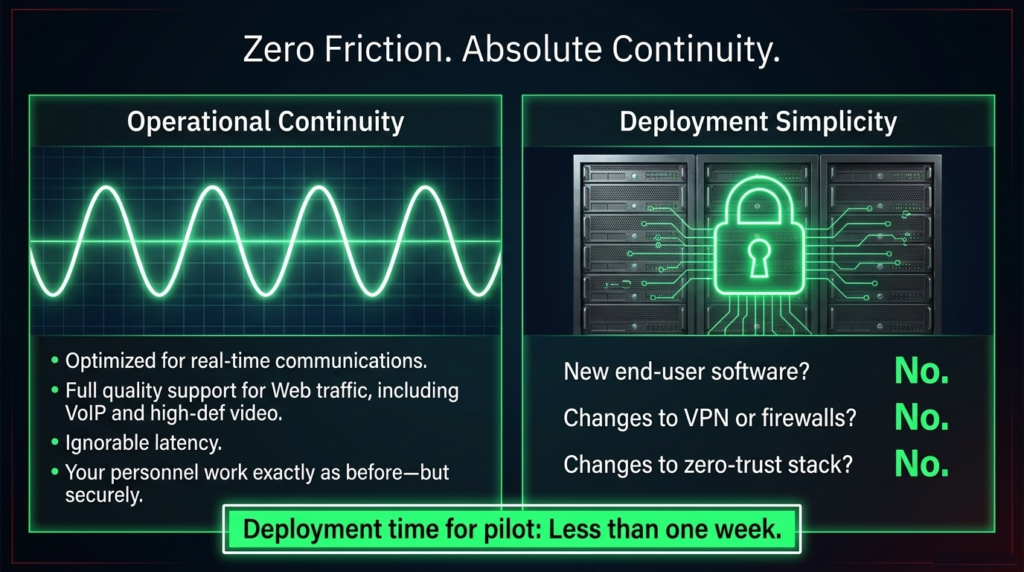
Zero Friction. Absolute Continuity in Government Digital Infrastructure
National systems fail quietly when data flow, authentication, and service delivery are interrupted across ministries, borders, and legacy platforms.
Government infrastructure is often designed as disconnected systems stitched together over time. Each integration adds delay, failure points, and operational overhead.
Zero friction architecture removes unnecessary barriers between systems, while absolute continuity ensures uninterrupted service flow across all government operations.
The Cost of Friction in Government Systems
Friction appears in authentication delays, manual approvals, duplicated data entry, and fragmented inter-agency communication.
These inefficiencies scale into national-level bottlenecks that slow down identity services, border control, taxation, and emergency response systems.
Absolute Continuity as a System Design Principle
Continuity means systems operate without interruption across updates, infrastructure changes, and regional deployments.
It requires resilient architecture that supports failover, redundancy, real-time synchronization, and uninterrupted identity validation flows.
Where Friction Typically Exists in Government Architecture
Most government ecosystems suffer from friction at integration points between legacy systems and modern platforms.
- Manual data transfer between ministries and agencies
- Non-standardized identity verification systems
- Fragmented API ecosystems across vendors
- Delayed synchronization between embassy and headquarters systems
- Inconsistent authentication layers across services
Engineering for Zero Friction Architecture
Zero friction systems are built on unified identity layers, standardized APIs, and automated workflows that eliminate redundant human intervention.
This enables seamless interaction between government services without repeated verification loops or administrative delays.
Achieving Absolute Continuity at National Scale
Absolute continuity requires distributed infrastructure, real-time replication, and resilient cloud-native systems designed for uninterrupted availability.
It ensures that critical services such as identity verification, visa processing, and tax systems remain operational under all conditions.
The Strategic Advantage of Frictionless Government Systems
Governments that reduce friction and enforce continuity improve service delivery speed, reduce operational costs, and increase system reliability.
More importantly, they gain stronger control over national infrastructure performance and responsiveness.
Friction is not just inefficiency.
It is a hidden tax on national speed, resilience, and digital sovereignty.